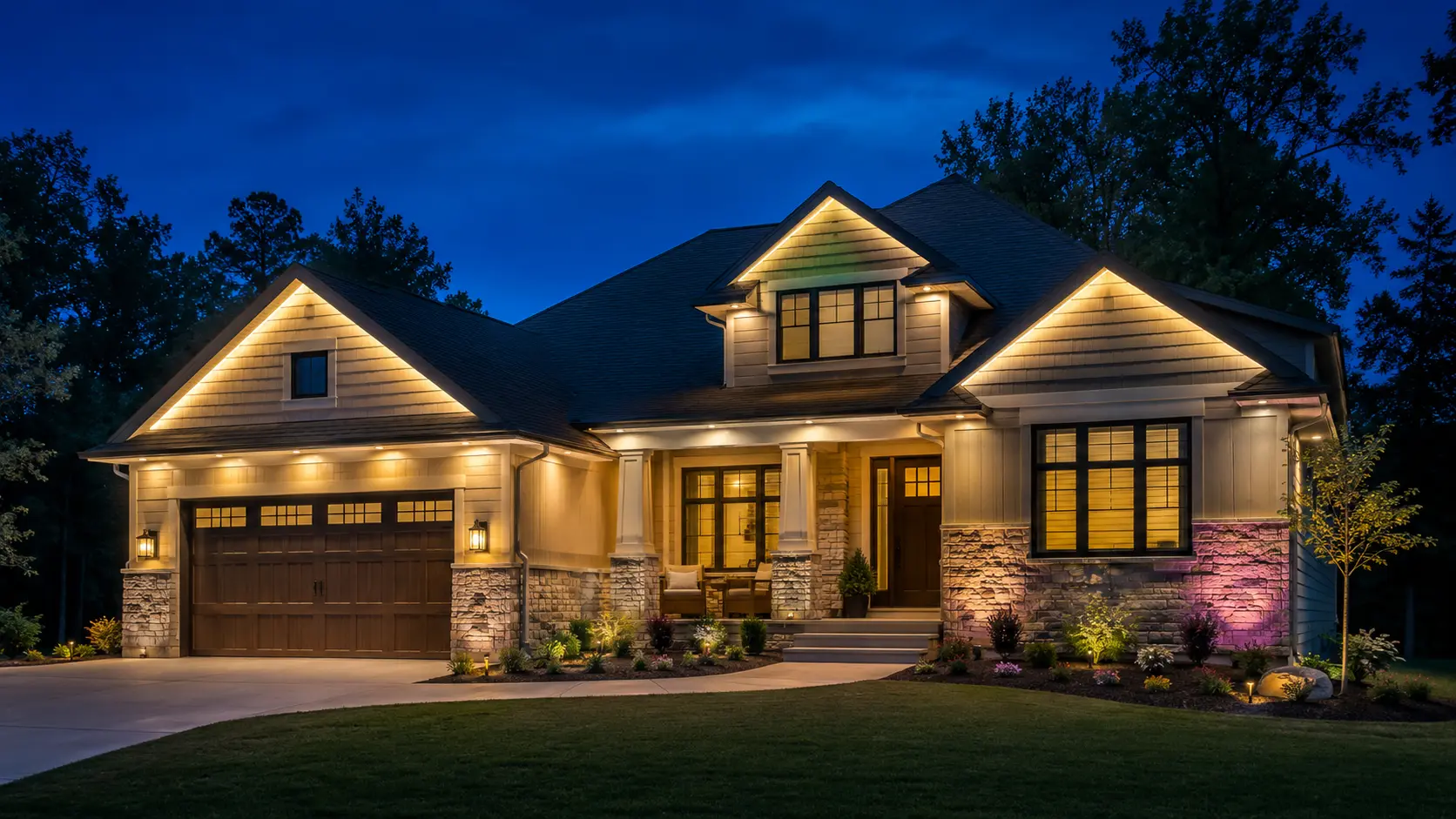
Permanent outdoor lights are weather-rated LED lighting systems designed to stay attached to a home throughout the year. They are commonly installed beneath eaves, along rooflines, under porch ceilings, or around other exterior features. Depending on the product, homeowners can control brightness, colors, patterns, zones, and schedules through an app, remote, or controller.
The main advantage: the lights are installed once and reused for holidays, events, architectural accents, and everyday use. However, a good result depends on careful measurement, a suitable mounting surface, safe power, weather-appropriate equipment, and compliance with local rules.
Quick Answer
Permanent outdoor lights can be a worthwhile upgrade for homeowners who want reusable and customizable exterior lighting. A DIY kit may suit a simple, safely accessible roofline with a suitable outlet. A professional system is usually better for tall homes, complex peaks, new electrical work, or hard-to-reach areas.
Before buying, confirm:
- The total length and shape of the area to be lit
- A safe, code-compliant power location
- A suitable mounting surface
- Outdoor suitability for every exposed component
- Any HOA, landlord, permit, or local-code restrictions
What Are Permanent Outdoor Lights?
The category includes both plug-in consumer kits and professionally installed systems. Most use small LED modules or “pucks” placed at regular intervals. When switched off, the modules and wires are intended to blend into the soffit, fascia, trim, or a matching channel. When switched on, they can create white accent lighting, holiday colors, animated patterns, or event-themed scenes.
Both DIY and professional products fit this category, but their price, repair options, and installation requirements differ.
Permanent roofline lights differ from temporary Christmas strings because they are chosen and installed for long-term attachment, outdoor exposure, and repeated operation.
How Do Permanent Outdoor Lighting Systems Work?
A typical system contains four main parts:
LED modules: The visible light sources may be pucks, nodes, strips, or fixtures inside a channel. Individually addressable systems can display different colors on separate LEDs.
Power supply: This converts household electricity to the voltage required by the lights. It must match the product’s voltage, wattage, and maximum supported run.
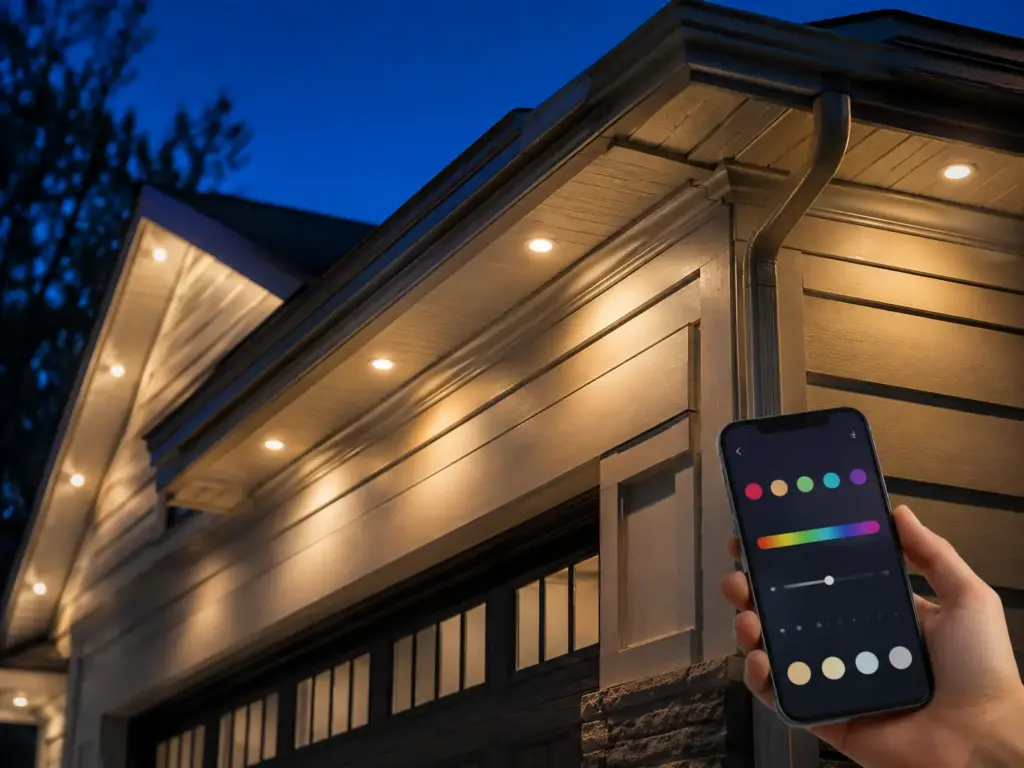
Controller: The controller manages colors, brightness, scenes, zones, and schedules through Wi-Fi, Bluetooth, a remote, or a wall control.
Mounting hardware: Clips, screws, adhesive pads, or a dedicated channel hold the system in place. A track can produce more even spacing and a cleaner appearance when the lights are off.
Never substitute an unapproved power adapter or cut and splice a system merely because the connectors look compatible. Follow the manufacturer’s limits and instructions.
Permanent Outdoor Lights vs. Traditional Christmas Lights
| Feature | Permanent outdoor lights | Traditional Christmas lights |
|---|---|---|
| Intended use | Year-round or repeated long-term use | Temporary seasonal decoration |
| Installation | One main installation | Installed and removed repeatedly |
| Appearance when off | Often concealed under eaves or in track | Wires and bulbs usually remain visible |
| Controls | Apps, zones, timers, scenes, dimming | Usually basic on/off or limited effects |
| Initial cost | Higher | Lower |
| Ongoing work | Inspection, cleaning, occasional repair | Annual hanging, removal, testing, and storage |
| Best for | Homeowners wanting convenience | Occasional decorators or renters |
NFPA guidance discussing the 2026 National Electrical Code notes that temporary holiday decorative lighting may be installed for no more than 90 days. Lights left in place permanently can require different wiring methods, wet-location suitability, GFCI protection, and local inspection.
Main Benefits
One System for Many Occasions
A single roofline can display holiday colors, event themes, or soft white architectural lighting. A neutral scene can look subtle rather than festive.
Less Repeated Ladder Work
You do not need to hang and remove the same lights every season. This is convenient, although the first installation may still require a professional when the roofline is high or difficult to access.
Efficient LED Technology
The U.S. Department of Energy says residential LEDs—especially ENERGY STAR-rated products—use at least 75 percent less energy and can last up to 25 times longer than incandescent lighting. Actual consumption still depends on system wattage, brightness, and operating hours.
Better Control
Timers, zones, and dimming help homeowners use only the lighting they need. A system can turn off automatically rather than remaining at full brightness all night.
Drawbacks to Consider
Permanent lighting costs more initially than a temporary string. It may also be difficult to conceal on homes without suitable eaves or soffits. Stucco, textured paint, irregular trim, very high peaks, and exterior-change restrictions can complicate installation. Current product testing also shows that some homes are simply less compatible with common DIY mounting methods.
Smart systems may depend on an app, controller, or manufacturer platform. Check offline controls, replacement-part availability, and controller support before buying.
Poorly aimed or excessively bright lighting can also disturb neighbors and contribute to light pollution. Permanent availability should not mean permanent operation.
Types of Permanent Outdoor Lights
DIY plug-in kits normally include segmented lights, a controller, power supply, clips, and adhesive. They suit straightforward and accessible rooflines.
Track-mounted or professionally installed systems use channels to hide wiring and maintain consistent spacing. Professional packages may add custom measurement, electrical work, app setup, warranty coverage, and service support, making them better suited to multi-story homes or complex architecture.
Step-by-Step Planning Guide
1. Define the Purpose
Decide whether the main goal is holiday decoration, curb appeal, patio use, architectural accenting, or visibility. This determines the required color quality, brightness, beam direction, spacing, and controls.
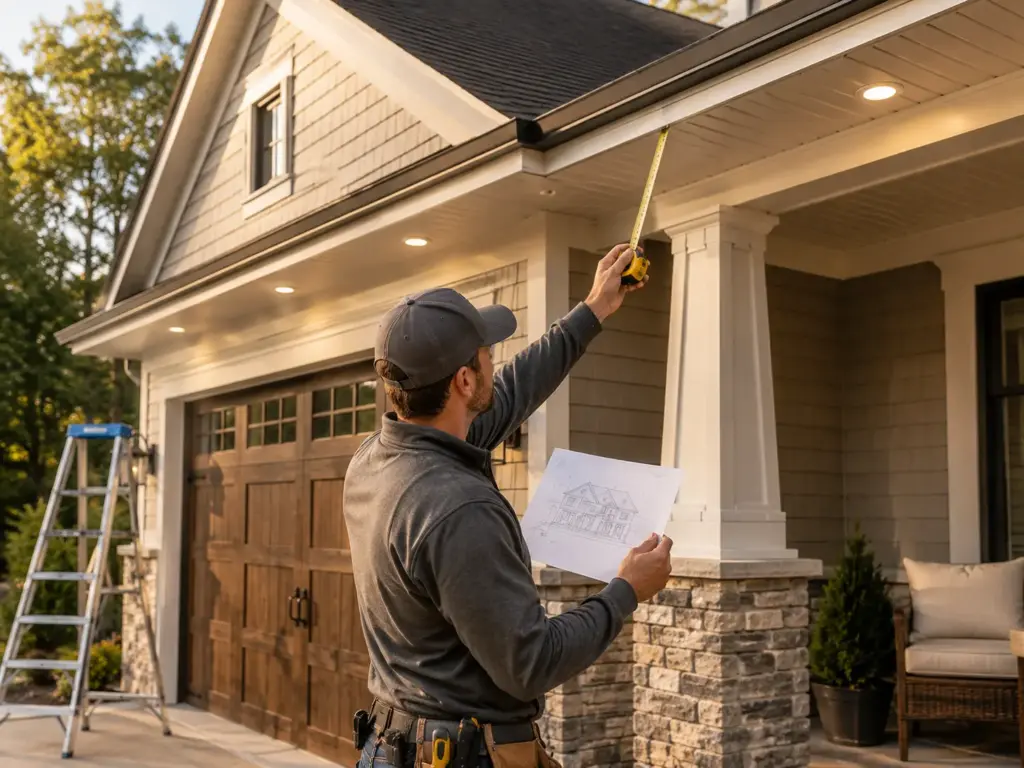
2. Measure the Complete Route
Measure every section, peak, corner, gap, and level. Do not assume a kit can be cut, split, or extended unless its instructions explicitly allow it.
Create a simple sketch of the house and mark:
- Each roofline section
- Peaks and corners
- Areas that do not need lights
- The proposed power location
- The controller location
- Doors, windows, gutters, and vents
This small planning step can prevent buying a kit that is too short or incompatible with the intended layout.
3. Inspect the Mounting Surface
Look for a clean, solid, accessible area. Identify vents, gutters, downspouts, cameras, flashing, and places where drilling could damage roofing or drainage components.
Adhesive mounting normally works best on clean and smooth surfaces. Textured paint, dusty soffits, extreme temperatures, and moisture can reduce adhesion. Mechanical clips or tracks may provide a more durable installation when they are approved by the manufacturer.
4. Plan the Power Location
The LEDs, controller, connectors, and power supply may have different exposure ratings. Do not assume every component can sit in rain.
The controller or power supply may need to be placed in a garage, weather-protected enclosure, or other sheltered location. NFPA guidance emphasizes GFCI protection for exterior receptacles.
Never run an indoor extension cord outdoors or route wiring where it can be crushed by a door, damaged by a gutter, submerged in water, or exposed to sharp metal edges.
5. Check Ratings and Certification
“Water-resistant” is not enough by itself.
UL explains that line-voltage outdoor luminaires are evaluated under UL 1598 with applicable wet-location requirements, while low-voltage systems may be evaluated under UL 1838 or UL 2108. An IP rating describes protection against moisture and dust intrusion, but it should be considered together with electrical certification and the installation instructions.
Check the markings for every major component:
- Light modules
- Connectors
- Extension cables
- Controller
- Power supply
- Mounting channel
- Outdoor receptacle or enclosure
A weather-rated light strand does not automatically make an indoor-rated controller safe outdoors.
6. Review Control and Repair Options
Check scheduling, dimming, zones, saved scenes, manual controls, maximum run length, replacement parts, warranty terms, and approved extension or splicing methods.
Ask these questions before purchasing:
- Will the lights work without an internet connection?
- Can they still be controlled if the app stops working?
- Are replacement sections available separately?
- Can individual failed modules be replaced?
- Does cutting the cable void the warranty?
- What is the maximum supported system length?
- Can the system handle separate roof levels or split runs?
These details can matter more over time than the number of available animations.
7. Plan Responsible Nighttime Use
DarkSky International and the Illuminating Engineering Society recommend lighting that is useful, targeted, no brighter than necessary, controlled, and warm-colored where possible. Aim light toward the home or ground, lower the brightness, avoid unnecessary late-night animation, and use timers.
A responsible everyday schedule might use low-brightness warm-white lighting during the evening and switch it off later at night. Brighter colors and animations can be reserved for short events or celebrations.
8. Choose DIY or Professional Installation
DIY may be reasonable for a low, accessible, plug-in installation supported by the manufacturer.
Use a qualified installer or licensed electrician for:
- New electrical wiring
- New exterior receptacles
- Dedicated circuits
- Hardwired equipment
- Multi-story rooflines
- Steep or difficult access
- Long custom runs
- Uncertainty about electrical codes
How Much Do Permanent Outdoor Lights Cost?
Cost depends on length, product quality, track, roof height, number of peaks, electrical work, labor, controls, warranty, and local market rates.
As a dated market reference, an April 2026 WIRED roundup listed selected 100-foot consumer kits at about $143 to $440. That is a snapshot of specific products, not a guaranteed price range.
For professionally installed lighting, Trimlight states that its dealer-installed systems commonly cost about $18 to $35 per linear foot, with location and property complexity affecting the final quote.
Compare whether quotes include track, controls, access equipment, electrical work, programming, warranty, and future service.
DIY vs. Professional Installation
| Choose DIY when… | Choose a professional when… |
|---|---|
| The route is low and safely accessible | The roofline is high, steep, or multi-story |
| The system is designed for plug-in DIY use | New wiring or hardwiring is required |
| The layout is simple | Peaks, gaps, and transitions are complex |
| You can follow the complete manual | You are uncertain about ratings or code |
| You accept future troubleshooting | You want installation and service support |
Do not perform electrical work beyond your training or local legal limits.
Common Mistakes to Avoid
Buying Before Measuring
Advertised length does not show whether the kit will handle peaks, gaps, separate roof levels, and the distance between the power supply and the first light.
Assuming Equal Weather Protection
The lights may tolerate outdoor exposure while the controller or power supply requires a sheltered location.
Cutting Without Approval
Unauthorized cutting or splicing can create connection problems, interrupt lighting effects, damage components, or void warranty coverage.
Using Temporary Products Permanently
The CPSC warns that inadequate wire size, strain relief, or overcurrent protection in seasonal decorative lighting can create shock or fire risks. Use products only for their marked purpose.
Relying Only on Adhesive
Dirt, texture, temperature, and moisture can weaken adhesion. Use the fastening method approved for the product and mounting surface.
Overlighting the Property
Bright animated scenes may suit special events but feel intrusive every night. Use lower brightness, shorter schedules, and warm-white settings for regular use.
Are Permanent Outdoor Lights Worth It?
They are most likely worth considering when you own the home, decorate regularly, have a compatible roofline, value flexible controls, and plan to remain in the property.
They may not be worthwhile when you rent, expect to move soon, face strict exterior rules, rarely use exterior lighting, or cannot provide safe power and mounting.
Ask these questions:
- Will I use the system during several seasons?
- Can it be installed without damaging the home?
- Is suitable power available?
- Can I afford installation and future maintenance?
- Are replacement parts available?
- Can I operate it without disturbing neighbors?
When most answers are yes, permanent lighting may be a practical long-term upgrade.
Frequently Asked Questions
Can permanent outdoor lights stay up all year?
Yes, when every part of the system is designed, rated, and installed for year-round outdoor use. Check the ratings of the controller and power supply as well as the lights.
Do permanent outdoor lights use much electricity?
LEDs are efficient, but usage depends on wattage, length, brightness, colors, and operating time. Use the product’s stated wattage and daily operating hours to estimate consumption.
Can permanent lights be installed on any house?
No. Houses without accessible eaves, with difficult mounting surfaces, tall rooflines, or exterior restrictions may require professional work or a different type of lighting.
Do I need an electrician?
Not always for a listed plug-in DIY kit used exactly as directed. Hire a licensed electrician when adding or modifying wiring, circuits, receptacles, or hardwired equipment.
Can roofline lights replace security lighting?
Not necessarily. Decorative lights may improve general visibility, but entry, path, and security lights should be selected and positioned for those specific purposes.
Should permanent outdoor lights stay on all night?
Usually not. Timers, dimming, and targeted zones reduce unnecessary energy use, glare, and nighttime light.
Do permanent outdoor lights increase home value?
There is no guaranteed increase. Buyer preference, daytime appearance, system condition, installation quality, and availability of replacement parts all matter.
Final Beginner’s Checklist
Before ordering, confirm:
- Exact length and layout
- Compatible mounting surface
- Safe power and controller placement
- Outdoor or wet-location suitability
- Recognized electrical safety certification
- Approved cutting and extension rules
- Timer, dimming, zones, and manual controls
- HOA, landlord, permit, and local-code requirements
- Replacement parts and warranty coverage
- A realistic DIY or professional installation plan
Permanent outdoor lights can turn repeated seasonal work into a flexible year-round feature. Treat the project as a small exterior lighting system rather than a long string of decorations.
Measure carefully, choose properly rated equipment, control brightness and operating hours, and use qualified help whenever the project involves difficult access or permanent electrical work.